Office drinking water for a Benoni staff kitchen
The client was a medium-sized office in Benoni, with a staff kitchen used by people coming and going through the day. They wanted a steady source of drinking water that would suit a busy workplace, cut down on bottle handling, and keep the kitchen area neater. The brief was simple enough on paper, but the site had a few practical points to deal with. The room was not large, the staff kitchen had limited counter space, and the building had regular load-shedding so the water solution needed to be planned properly.
They also wanted a system that would not create extra admin for office staff. No one wanted to keep ordering crates, storing containers, or dealing with empty plastic. The site manager asked for something that could run quietly in the background and deliver water through normal working hours. Because the building is in Benoni, we also took into account seasonal humidity changes and the general air quality around an active commercial area. That matters with atmospheric water generation, since output changes with the weather.
What the site needed before installation
Before we fitted anything, we checked the kitchen layout, power points, ventilation, access for maintenance, and where the drain could be routed. We also looked at the likely daily water demand. In a staff kitchen, the demand is usually spread out across the day, with tea, coffee, drinking glasses, and a few visitors. You do not need a huge plant room, but you do need the right balance between output and storage.
- Available space beside the sink and under the counter area
- Single-phase electrical supply with protection for compressor starting load
- Drain route for condensate and cleaning water
- Clear access for filters, service panels, and routine inspections
- Stable installation point away from direct heat and dust
There was also a concern about noise. The client did not want a loud machine in a kitchen shared by admin staff and visitors. So we checked the likely operating sound in relation to the room use, then positioned the unit where it would not become a nuisance during meetings or lunch breaks. Small thing, but it makes a big difference in an office.
The atmospheric water generator we supplied
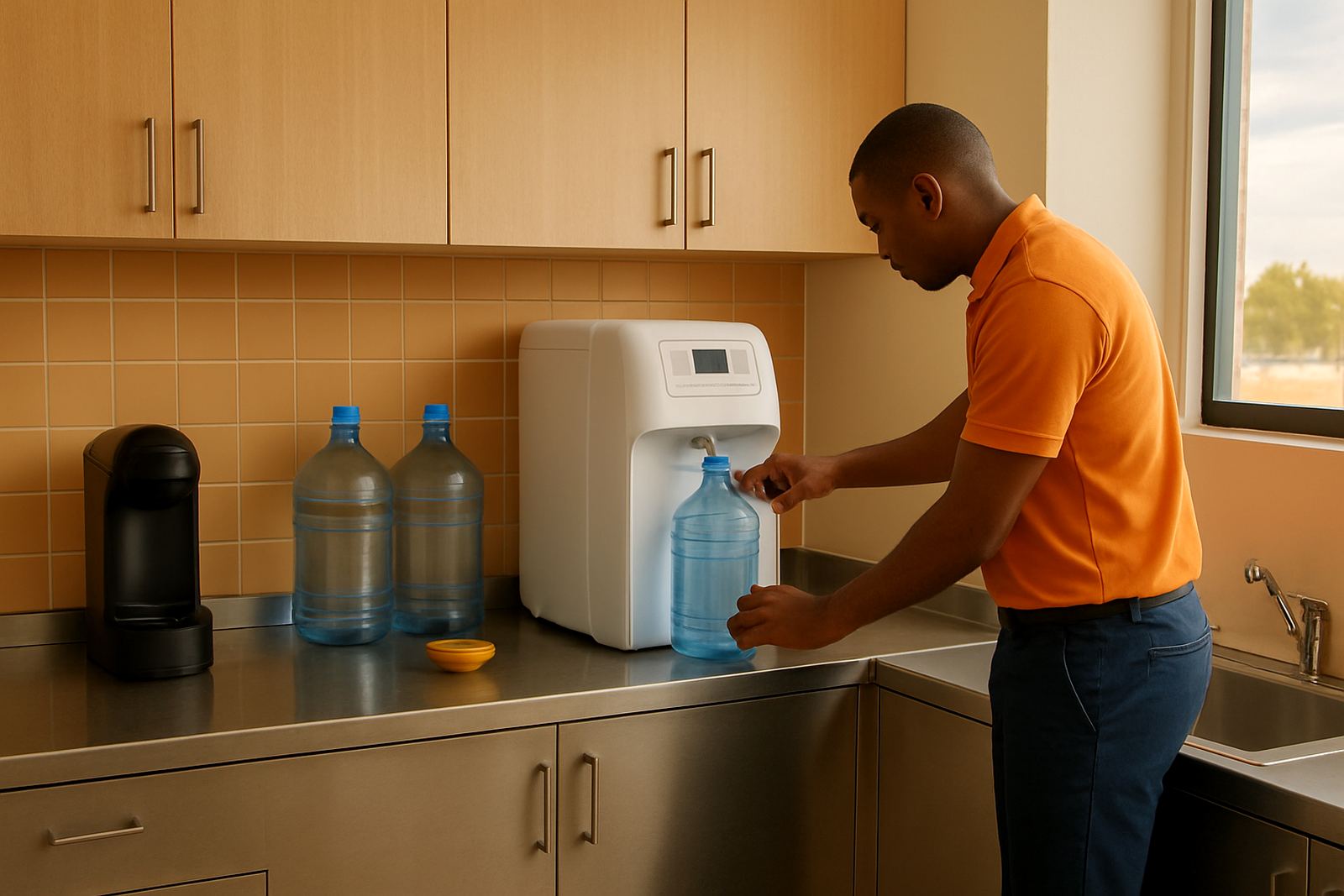
We supplied an atmospheric water generator sized for office use, with integrated treatment stages and a storage tank suitable for day to day consumption. The unit draws moisture from the air, condenses it, and then runs the water through filtration and purification before it reaches the tap point. For this project, the emphasis was on dependable drinking water for staff, not on bulk industrial output. We matched the unit to the expected occupancy so it could handle regular use without being overworked.
The fitted system included a built-in filtration train, UV treatment, and insulated storage. We also set it up with proper drainage and easy access for periodic filter changes. Because the office is in Gauteng, we factored in the dry winter periods and explained to the client that output would vary a bit with ambient humidity. That is normal for any atmospheric water unit. On drier days, the system still runs, but yield drops. Planning for that upfront avoids surprises later.
- Office-grade atmospheric water generator
- Integrated filtration and UV treatment
- Storage tank sized for staff kitchen demand
- Condensate and waste-water drainage
- Service access for filter and hygiene checks
Supply and fit in a working office
Our team handled the full supply and fit, from unloading to final handover. Pieter’s installation crew positioned the unit, connected the services, levelled the unit, and checked the drainage fall so water moved away properly. Ayesha coordinated the schedule so the work did not interfere with office hours more than necessary. The client wanted the kitchen available at the end of the day, so we planned the install around that. It was a straightforward job, but the detail matters when you are working in an occupied building.
We also explained the cleaning and daily checks to the office contact person. The staff only needed to keep the area clean, monitor the status lights, and report anything unusual. No complicated operating steps, which is what most offices want. We supplied the handover notes with the basic maintenance points, filter intervals, and what to watch for during load-shedding or after power returns. Sibusiso also checked the controls and confirmed the unit would restart correctly after an outage.
Installation took 1 week from site check to final commissioning. That included the layout check, supply coordination, fitting, testing, and handover. For a Benoni office kitchen, that was a practical turnaround without dragging the project out.
Commissioning, water quality checks, and staff handover
Once the unit was in place, we carried out commissioning and checked operation under normal conditions. We tested start-up, storage recovery, drain flow, and the treatment stages. Water quality was checked before the system was handed over for daily use. The office team wanted a clean result that could be used straight away, and that was achieved without delays.
We also walked the client through the difference between atmospheric water generation and ordinary filtration. That point is important. The unit still needs suitable air conditions and routine maintenance, but it is not relying on a bottled supply or a direct municipal feed in the same way a basic dispenser would. In practical terms, it gave the office a reliable drinking water setup with less handling and less clutter.
- Start-up and recovery tests completed on site
- Water checks completed before handover
- Operating instructions provided to the office contact
- Maintenance intervals explained for filters and hygiene care
What changed after the project was completed
The biggest change for the client was convenience. Staff no longer had to deal with separate water deliveries or storage around the kitchen. The space looked tidier, the water point was in one fixed place, and the office could plan around a consistent supply during the work week. There was also less admin for the facilities side, which is often where these projects pay for themselves.
For us, the main success was matching the equipment to the actual site use. This was not a factory, hospital, or high-volume canteen. It was a working office with a sensible demand profile, a limited footprint, and a need for simple upkeep. By keeping the spec tight and the installation neat, we avoided over-specifying the job. If we were to do this one again, we would follow the same process: check the space first, confirm the power and drainage, size the unit to the number of users, and make sure the client understands the seasonal variation in output. That approach works well in Benoni and across Gauteng, especially in office buildings that need practical water solutions without fuss.
Key facts
| Project type | Office drinking water installation |
|---|---|
| Town | Benoni, Gauteng |
| System supplied | Atmospheric water generator |
| Application | Staff kitchen drinking water |
| Timeline | 1 week |
| Scope | Supply, fit, commissioning and handover |